
 En
En  Fa
Fa 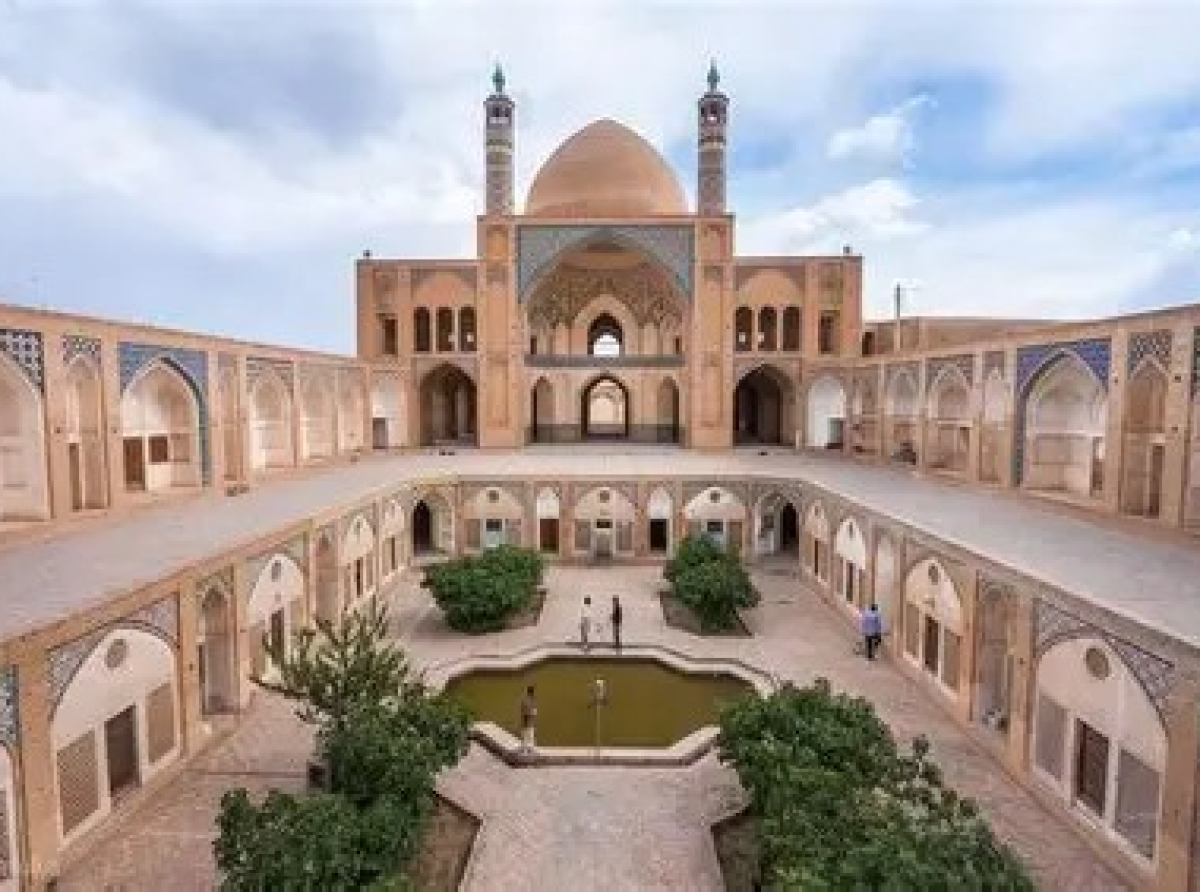
Kashan is a city rich in history, and in every corner of it, you can find a unique example of these works. The Agha Bozorg Mosque is one of the most spectacular attractions of this city, located in the alleys of the same name and can be easily found. This mosque is actually a large mosque and school complex attributed to (Mullah Mehdi Naraqi) known as (Agha Bozorg), one of the Shiite religious authorities in the past. This building is used by both the public and students, and its foundation stone was laid by a benevolent man named Hajj Mohammad Taqi Khanban and his son in the 13th century AH, during the reign of Mohammad king Qajar. The exquisite decorations and elements of this mosque's spectacular appearance dazzle every eye; from the Muqarnas carvings on the mosque's entrance to the delicate stucco and eye-catching tiling, all of which have made this mosque a popular attraction and host to many tourists. In addition, Agha Bozorg Mosque is the only five-story mosque in the Islamic world, and this feature multiplies its importance.
In the year 1221 AH, coinciding with the reign of Mohammad king Qajar, Haj Mohammad Taqi Khanban decided to create a place for congregational prayers for the general public and a classroom for his son-in-law, (Mullah Mehdi Naraqi).
He chose a spot in Kashan and after 8 years, he opened the mosque (Agha Bozorg) to the public in 1227 AH, coinciding with the first years of Nasser al-Din king's reign.
The Agha Bozorg Mosque and School of Kashan was built at a time when the first signs of Western influence were visible in Iranian architecture. Western inspiration is also evident in structures such as the Ali Qapu Palace in Isfahan and the Golestan Palace in Tehran.
While this building is built based on the principles of Iranian architecture, it also exhibits undeniable differences and innovations. This shows that the architect of the building was both mindful of the changes of his time and committed to the enduring values of past architecture.
Since Iranian architecture continued in a different style after this period, few buildings were built with these principles; as a result, fewer buildings of this type are seen today, and the (Agha Bozorg) complex is among the unique buildings in Iran.
The great mujtahid of Kashan, Mullah Mohammad Mehdi Naraqi, passed away at the same time as his last child was born, and according to the custom of the time, his son was named after him. After a while, the son became a mujtahid like his father; to avoid confusion due to the similarity of names, the people of Kashan called the father "Agha Bozorg" and the son "Agha Kouchak". During Mohammad king Qajar's trip to Isfahan and his stay in Kashan, he met with the city's scholars, including (Agha Kouchak).
The king noticed Aghakouchak's high academic rank and then ordered that he also be called (Aghabozorg). Hajj Mohammad Taqi Khanban, the governor of the city at the time, was commissioned to build this mosque and school and also married his daughter to him. It is said that during a meeting between the king and the scholars, the king, after learning about Mullah Muhammad Mahdi's scholarly status, asked him and the other scholars to tell him whatever they wanted. Mullah Muhammad Mahdi asked the king to keep the mosquitoes away from them, and the king replied that he was unable to do so; then he was asked to build a mosque for the people to pray in.
National Registration: The name of this work was included in the list of national works of the country on December 11, 1951, with number 382, and it is considered one of the valuable works of our country.
Translator:Fatemeh Abbaszadeh
